

In a sudden and unexpected move, Nepal’s Inland Revenue Department (IRD) has decided not to extend the tax filing deadline for businesses, a change that many see as damaging, particularly for small enterprises and startups. The decision, made just as the country prepare for its major festive season, has left businesses with a tight 12-day window to file their income statements. This sudden shift in policy is raising significant concerns about the timing and the potential impact on Nepal’s new business landscape.
As Nepal’s economy struggles with corporate scandals, a banking sector struggling to issue loans, and a slowing market, the government’s decision to strictly enforce tax deadlines without extensions adds unnecessary pressure to the country’s small businesses.
Rather than upgrading its own digital infrastructure to handle the influx of filings, the IRD is pushing businesses to work around an inadequate system with little deadline and festive season looming large. The move exposes how government entities are passing responsibility onto taxpayers instead of making much-needed improvements to their own systems.
The new tax deadline policy is a flawed approach
On September 23 (Ashoj 7, 2081), the IRD announced that small businesses, especially those with transactions under NPR 10 million annually, would not be eligible for tax filing extensions this year through the announcement posted in their website as below:
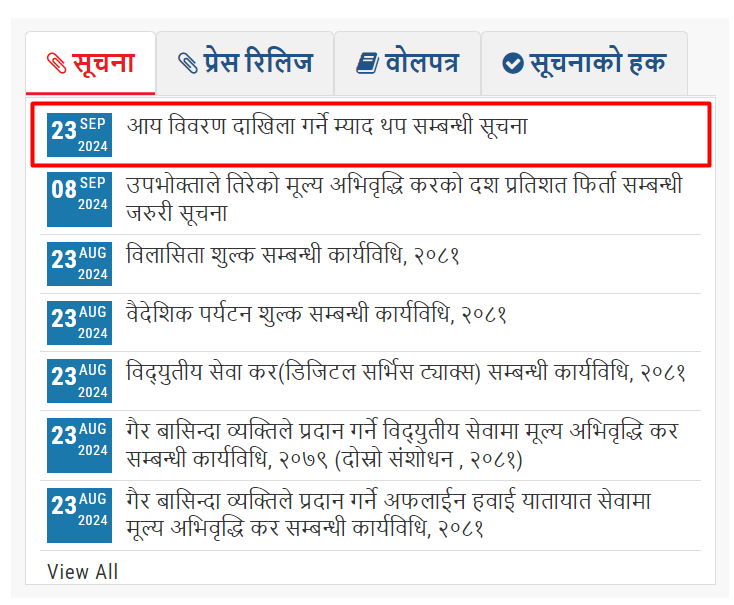
This new policy comes into force despite existing legislation in the Income Tax Act 2058 that allows businesses to apply for up to three months of deadline extensions under reasonable circumstances. The government’s rationale is the heavy workload on the IRD’s online system, which is reportedly struggling to handle tax submissions at the end of the fiscal year. Instead of improving its infrastructure, the IRD has decided to limit the extension options for businesses. The announcement even if posted on September 23 on their website and released on that date does state that the decision was made 3 days prior. View full notice as below:

The decision comes from the government’s interpretation of Nepal’s Income Tax Act, 2058 (Section 98), which previously allowed for a three-month extension for businesses to file their income statements. The new ruling, however, eliminates this flexibility for firms with annual transactions up to NPR 10 million. These businesses must now submit their income tax returns by the end of Ashoj without any extensions, while larger businesses have been given some additional time until end of Mangsir or Poush 20, depending on their turnover.
As a result, small businesses must meet the existing deadline – falling at a time when roughly only 12 working days remain due to the ongoing festival season. The timing could not be worse, and the decision has been criticized as unfair to small enterprises that are already dealing with liquidity issues, lack of market demand, and economic uncertainties.
Looking at the bigger picture for economic strain
Nepal’s current economic state provides important context for understanding why this new tax policy has caused outrage. Several factors are putting immense pressure on businesses:
- Corporate scams and financial mismanagement: Over the past few years, corporate fraud and financial mismanagement have broken the trust even further in Nepal’s corporate sector. Major cases like the fake VAT bill scam shook public confidence, with billions of NPR worth of fake VAT receipts unearthed. The judiciary has been slow in prosecuting the fraudsters involved, creating a perception of impunity. This corruption is straining the government’s ability to collect revenue effectively and fairly, resulting in increased probe on smaller, more compliant entities while larger corporations escape penalties.
- Banking sector inactivity: Nepal’s banking sector has been hit hard by liquidity issues. Despite having a significant amount of cash in reserves, banks are not lending as expected due to regulatory uncertainty and low market demand. According to Nepal Rastra Bank (NRB), private sector lending has been growing at extremely slow rate. Several banks have liquidity positions that are strong enough to lend, but the ongoing economic slowdown and high interest rates are discouraging investment. This has hampered businesses, especially small enterprises that rely on loans for expansion and operations. Adding the pressure of rigid tax deadlines, during such economic uncertainty, only makes the situation worse.
- Festive season pressure: With the Dashain festivals falling in the same month as the tax deadline, businesses are already occupied with high operational demands. In Nepal, the festive season is a crucial time for retail, hospitality, and many service-oriented businesses. Expecting businesses to file taxes within the brief, 12-day window during this period is both impractical and unrealistic.
How this affects new and small businesses
The tax deadline policy unfairly affects new and small businesses, which form the backbone of Nepal’s economy. While large corporations are often able to comply with the deadlines by leveraging better resources, smaller businesses lack the same capacity. Startups and solo entrepreneurs will bear the pressure of the decision, as they often don’t have access to in-house accountants or compliance officers.
Moreover, the tax policy discourages entrepreneurship at a time when the government should be doing everything possible to stimulate growth. Without easier access to financial leverage tools and governmental support, new ventures are finding it increasingly difficult to survive. The tax burden, combined with an inability to access much-needed liquidity, leaves small businesses in a precarious position.
Underperforming online system: Why blame the users?
Nepal’s digital infrastructure for tax collection is far from perfect. The government itself has admitted that its system experiences “heavy load” during peak filing periods, which often causes delays, crashes, and interruptions. Yet, rather than upgrading its IT capabilities to accommodate these volumes, the IRD has decided to pass the problem onto businesses by enforcing stricter deadlines with little to no time to spare.
This approach ignores the real issue: the government’s outdated and inadequate technology. Why not just upgrade it?
Countries like India and Australia, by contrast, offer more lenient tax deadlines and have invested heavily in robust online systems to facilitate smooth filing processes. India’s income tax filing system, for example, offers an extended nine-month window for submissions and several automated features to help businesses comply more efficiently. Nepal’s failure to address the shortcomings in its system not only frustrates taxpayers but also adds unnecessary costs as businesses spend more on accounting services to meet the rigid deadlines.
The Broader Implications for Economic Recovery
Nepal is at a critical point in its post-pandemic recovery, with the private sector playing a crucial role in driving growth. However, harsh tax policies and sudden change in regulations with so little time to spare are likely to hold back this progress. With the current economic slowdown, businesses are already facing numerous hurdles. In such an environment, punitive tax regulations can discourage investment and further slow down (already slow) economic activity.
To ensure that Nepal’s economy does not stall, the government must take a more proactive and supportive role. It should look into policies that promote businesses rather than punish them. For example, it could offer tax rebates or deferrals for businesses struggling due to liquidity constraints. Most importantly, it should focus on upgrading its digital systems to ensure that businesses are not penalized due to the government’s shortcomings.
Call for systemic improvement
The current decision by the IRD to restrict tax deadline extensions highlights a much bigger issue in Nepal’s governance: the failure to invest in the necessary infrastructure that supports economic growth. Small businesses, startups, and entrepreneurs are the most affected by these decisions, and the policy comes at a time when businesses are grappling with the effects of a struggling banking sector, corporate fraud, and post-pandemic recovery challenges.
Rather than offloading its inefficiencies onto taxpayers, the government must focus on upgrading its digital systems, providing financial support, and ensuring that the economic environment remains conducive to growth. Only through systemic improvements can Nepal ensure that its businesses thrive in the face of mounting challenges.


