In a dramatic escalation, the protests in Bangladesh have taken a violent and deadly turn, with conflicting reports on the death toll and severe internet shutdowns further fueling unrest. Despite efforts to curb the unrest by closing universities indefinitely, demonstrations continued, particularly in Dhaka.
Table of Contents
Escalation of Violence
The protests, initially sparked by opposition to a controversial quota system in government jobs, have become increasingly violent. This even after Supreme Court order pausing the quota system, students do not trust the government’s intentions and believe it will find a way to keep the system in place resulting in the situation we witness.
The protest took a turn after the government labeled the protesters as “Razakars,” an offensive term for collaborators of Pakistan, which incited anger and aggression among the Bangladesh Chhatra League (a student body affiliated with the ruling party).
This escalation of violence reflects the deep-seated distrust and frustration among the students towards the government.
Reports from various posting indicate a significant disparity in the death toll. Media outlets report casualties in the 20s, while local student groups claim that over 50 individuals have been killed, with thousands more injured. This discrepancy highlights the chaotic nature of the situation and the challenges in obtaining accurate information.
Government Response and Internet Shutdown
In response to the escalating protests, the Bangladeshi government has implemented a complete internet shutdown. This move, aimed at choke the organization and communication among protesters, has drawn widespread criticism. Amnesty International has called for de-escalation and respect for protesters’ rights, emphasizing the need for law enforcement to exercise restraint and ensure human rights compliance. While “KeepItOn coalition” – a global network of over 300 civil society organizations from 105 countries worldwide working to end internet shutdowns has written to “Honourable Asaduzzaman Khan, Minister of Home Affairs, and Honourable Zunaid Ahmed Palak, State Minister of Posts, Telecommunications and Information Technology” to immediately restore connectivity.
The Role of International Attention
International human rights organizations and local activists have been vocal about the government’s response. The widespread use of excessive force, arbitrary arrests, and the internet shutdown are seen as attempts to curb the protests and limit the spread of information. The global community, including organizations like Amnesty International, has urged the Bangladeshi authorities to respect the rights to freedom of expression and peaceful assembly, highlighting the potential human rights violations involved in the crackdown.
Historical Context and Implications
Historically, Bangladesh has witnessed significant political unrest and protests, particularly surrounding election periods and controversial government policies. The current situation mirrors past conflicts where government measures to control dissent have led to greater turmoil and international condemnation. The protests, demanding the resignation of Prime Minister Sheikh Hasina and the establishment of a caretaker government, are indicative of deep-seated political divisions and dissatisfaction among the populace.
Impact on Local Communities
The internet shutdown and violent crackdown have profound implications for local communities, particularly students and activists. The disruption of communication channels has made it difficult for protesters to coordinate and for information to reach the broader public. This has led to heightened anxiety and uncertainty, exacerbating the already tense situation.
Protest movement organizer statement
While in an interview to DW News, ASF Mahmud, one of the main organizers of the protest movement, stated that the government has used agitators and security forces to attack peaceful demonstrations. Even while recording a statement, Mahmud reported that bullets were fired at protesting students, and an ambulance driver transporting an injured student was shot to death.
Nepal Foreign Ministry & Embassy Response
There’s no official response since after July 17 from Embassy of Nepal, Dhaka – when the major unrest started where the statement published in all it’s communication channel asked students to stay at home and do not move out unless absolutely must:
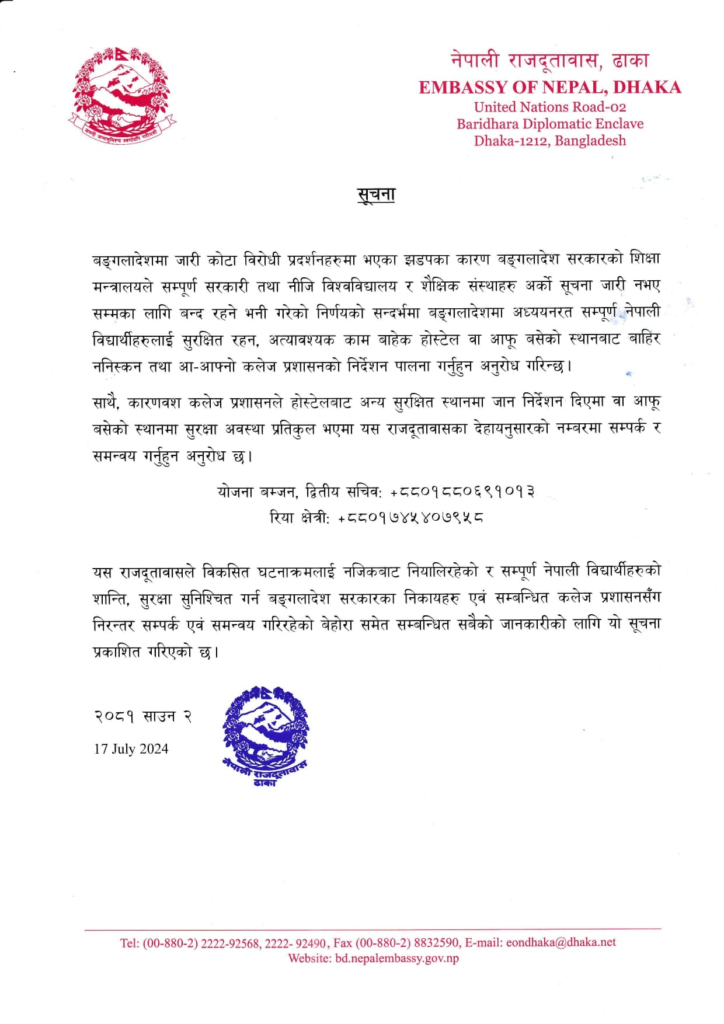
The Ministry of Foreign Affairs, however, has reported that some students have returned to Nepal, with others traveling via road through India. The internet outage has hindered students from booking air tickets, but the ministry assures that all Nepali students are currently safe. There are tentatively 4,000 students currently studying in Bangladesh.
“Continuous contact is being maintained with the embassy. The embassy is also facilitating the return of students who wish to come back home. Students are returning both by air and road,” spokesperson Rai told when asked by Nepali news portal Ratopati.
The ongoing protests in Bangladesh represent a critical juncture in the nation’s political landscape. The escalating violence, conflicting reports on casualties, and the government’s stringent measures, including the internet shutdown, highlight the urgent need for de-escalation and a peaceful resolution. As the situation continues to unfold, the role of international organizations and the global community will be crucial in advocating for human rights and supporting the voices of the Bangladeshi people.