

The harsh living conditions of the Sukumbasi community, commonly referred to as squatters, has been a continuous social issue in Nepal, marked by a series of legal battles and public outcries. The recent Supreme Court verdict announced by Hon. Justice Dr. Ananda Mohan Bhattarai and Hon. Justice Binod Sharma, detailed in the article, has brought renewed focus on the complexities surrounding this issue. This article looks a bit into the historical context, the current verdict, and the reactions from various stakeholders, providing a balanced analysis of the situation.
Table of Contents
Historical Context
The term “Sukumbasi” in Nepal refers to landless individuals who have settled on public or unclaimed land. The starting point of the Sukumbasi settlements can be traced back to several socio-economic factors, including internal displacement, poverty, and urban migration. Over the years, these settlements have grown, leading to conflicts with government authorities and private landowners.
In the past, several attempts were made to regularize these settlements and provide legal ownership to the squatters. However, these efforts were often spoilt by bureaucratic inefficiencies and political interference. The issue remained largely unresolved several decade after it’s initiation, causing tension between the squatters and the authorities.
Recent Court Ruling
On December 19, 2023, the Supreme Court of Nepal issued a landmark verdict addressing the eviction and resettlement of landless squatters in Kathmandu. The full verdict for the same is released only few days earlier on July 16, 2024. The ruling mandated the identification and relocation of genuine landless squatters to designated housing facilities. Specifically, the court directed that:
- Identification and Relocation: Genuine landless squatters should be identified and relocated to the housing facilities currently available in Ichangu Narayan. The construction of these housing was initiated in July 2012 and was completed in September 2014. It does include 227 housing units and costed an estimated NRs. 120 million to complete.
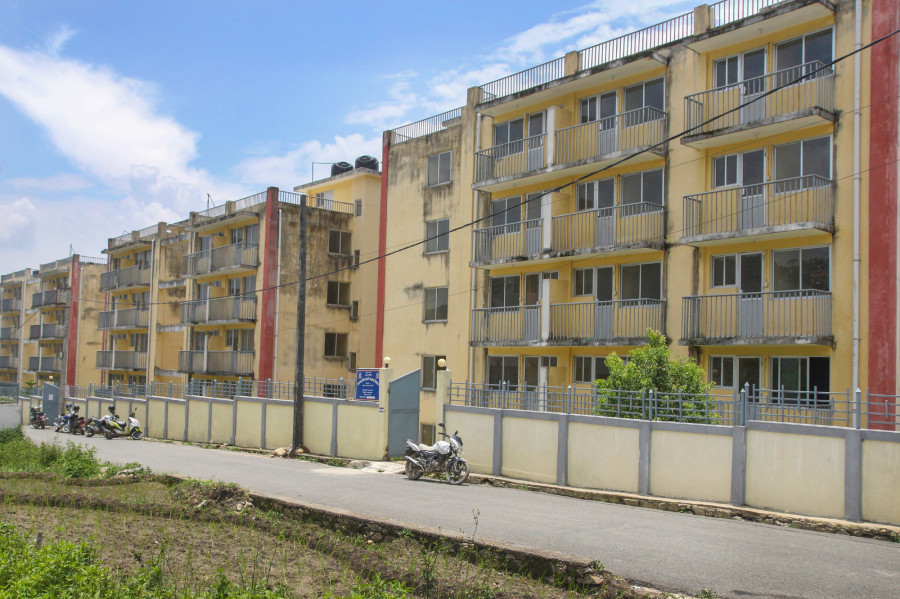 Photo credit: Tsering D Gurung/TKP
Completed nearly 10 years earlier – they have not yet been used for the purpose they were built for. If these facilities are insufficient, additional housing arrangements should be made as per the court order. Kathmandu Metropolitan City wants to resolve the issues at the earliest and are even willing as per their previous statements to relocate the people impacted to hotels while covering their expenses to facilitate easy transaction. - Immediate Relief: For squatters unwilling to move to the designated housing, immediate relief in the form of financial assistance should be provided to facilitate their relocation and the removal of encroachments.
- Risk Mitigation: In the first phase, structures at high risk of flooding should be removed, followed by the removal of settlements occupying green spaces between rivers and roads.
- Coordination Among Local Authorities: The court emphasized the need for coordination among all local authorities within the Kathmandu Valley to execute this plan effectively.
- Execution by the High Powered Committee for Integrated Development of the Bagmati Civilization (अधिकार सम्पन्न वाग्मती सभ्यता एकीकृत विकास समिति): The court verdict did include multiple other details other than the specific stakeholder we’re reviewing for here – as such the verdict designated the High Powered Committee for Integrated Development of the Bagmati Civilization as the authority responsible for executing these orders.
Reactions and Implications
Government and Legal Perspectives
The government’s response to the Supreme Court ruling has been largely supportive, with officials highlighting the importance of balancing humanitarian concerns with environmental and public land management. The decision to provide immediate financial relief to genuine squatters is seen as a pragmatic approach to address their immediate needs while ensuring compliance with the court’s directives. Much is to be seen on how exactly the government puts their words into action to resolve this issue at the earliest.
Sukumbasi Community
The landless squatters, however, have expressed mixed reactions to the verdict. While some see the provision of housing and financial assistance as a step in the right direction, others feel that the ruling falls short of their expectations. The primary demand of the Sukumbasi community has been for land ownership, not just temporary housing or financial aid. Many squatters have lived in these informal settlements for decades, establishing deep roots in their communities, and are reluctant to move to new locations.
Environmental and Urban Planning Advocates
Environmentalists and urban planners have welcomed the court’s decision, emphasizing the need to protect riverbanks and other ecologically sensitive areas from encroachment. They argue that unplanned settlements contribute to pollution and increase the risk of natural disasters, such as flooding and landslides. This was clearly demonstrated by the recent rainfall where these areas were flooded completely.

The removal of settlements from these areas is seen as a necessary step to restore the natural environment and improve urban infrastructure per environmental and urban planning advocates.
Broader Social Impact
The ruling has triggered a broader debate on social equity and urban development in Nepal. The Sukumbasi issue underscores the challenges faced by marginalized communities in accessing housing and land rights. It also highlights the need for comprehensive urban planning policies that address the needs of all residents, including the most vulnerable.
Moving Forward
The Supreme Court’s verdict represents a significant step towards resolving the longstanding Sukumbasi issue. However, its implementation will require careful coordination among government agencies, local authorities, and the Sukumbasi community. Ensuring that the relocation process is carried out humanely and respectfully will be crucial in gaining the trust and cooperation of the affected families.
Moreover, the government must continue to explore long-term solutions to address the root causes of informal settlements. This includes developing affordable housing policies, creating job opportunities, and ensuring access to essential services for all citizens.
The Sukumbasi case is a complex issue that reflects broader challenges in urban development, social equity, and environmental management in Nepal. The Supreme Court’s recent ruling provides a framework for addressing these challenges, but its success will depend on the effective implementation of the court’s directives and the willingness of all stakeholders to work together towards a common goal. As Nepal continues to urbanize, finding sustainable solutions to the Sukumbasi issue all around the country will be essential for building inclusive and resilient cities.
The verdict revolved largely for the conversation of Bagmati river and it's surrounding area and not just Sukumbasi Case - it was one of the aspect that the verdict touched upon and one we discussed about.
References
- Supreme Court full verdict for the case:
2. वास्तविक सुकुम्बासी स्थानान्तरण गरेर नदी किनार खाली गर्न सर्वोच्चको आदेश
3. सुकुम्बासीलाई पैसा दिएर भए पनि नदी किनार खाली गर्न परमादेश


